
Issue
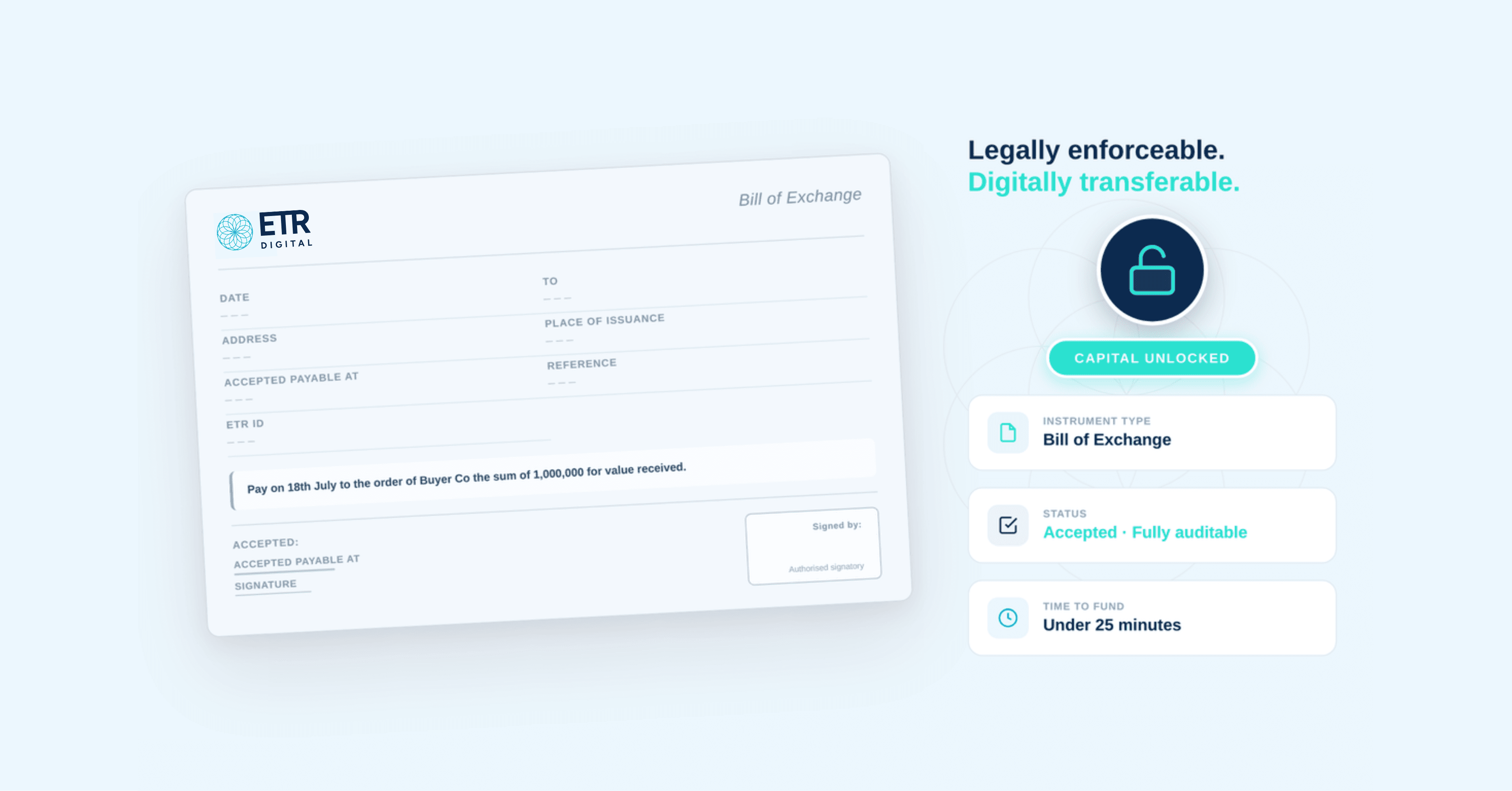
A bill of exchange is created digitally with the payment obligation, parties and maturity defined and recorded.
Issue, transfer, finance and settle bills of exchange through a controlled digital process, built on established negotiable-instrument law.
A digital bill of exchange is a bill of exchange created, transferred and managed as an electronic record rather than on paper. It carries the same legal characteristics the instrument has always had, a defined payment obligation, an identifiable party who must pay, a fixed maturity, and the ability to be transferred and financed. What changes is the process around it, which becomes digital, auditable and considerably faster.
At ETR Digital, digital bills of exchange sit within a broader category of digital negotiable instruments we call Working Capital Notes™. The instrument is familiar. The execution is modern.
A bill of exchange is created digitally with the payment obligation, parties and maturity defined and recorded.
Ownership passes electronically, with each transfer authenticated and recorded in a verifiable chain of title.
A bank or funding provider can finance or discount the instrument, giving the holder earlier access to liquidity.
On the maturity date, the obligor settles the instrument with the current holder, and the lifecycle closes with a complete record.
Aligned with the UNCITRAL Model Law and UK Electronic Trade Documents Act 2023.
Protected by a single authoritative record, tamper-evident controls, verified ownership and secure transfer.
API-first and platform-agnostic, designed to integrate with existing treasury and ERP workflows.
Every trade flow is different. If you are exploring how bills of exchange could work as digital instruments, we would be glad to talk it through.
Bills of exchange have moved value across borders for centuries. The instrument is proven. The process around it is not.
For treasury and trade-finance teams, the friction is common. Paper documents must be created, signed, couriered and stored. Ownership is transferred by physical endorsement. Verifying that an instrument is authentic, unique and enforceable takes time that working capital cannot spare.
The result is a slow, manual layer sitting on top of an otherwise sound instrument.
A faster, cleaner route to mobilising trade instruments without the manual document burden.
Instruments with clearer provenance, verifiable ownership and richer lifecycle data.
A digital process that preserves the legal standing of the bill while removing paper handling.
A practical tool for releasing liquidity held in approved trade flows.
A digital bill of exchange is not a new financial product. Compared with a paper bill, it removes physical handling, shortens transfer and verification, and provides a continuous audit trail. Compared with approaches such as reverse factoring or receivables finance, it offers the distinct legal characteristics of a negotiable instrument.
Which approach suits a given programme depends on the counterparties, the jurisdiction and the objective.